Weekly #19

Working on anatomy mornings and afternoons for the past 3 weeks at my Atelier. Let me show you some of what I’ve done.

More skeleton drawing from the model:

Some block-ins and rendering, just to remind myself those things still exist:


And finally, more anatomical drawings, this time building muscles and a skeleton after drawing the figure in a certain pose:

I am working on this one with an anatomy book open beside me, putting on one muscle after another, taking note of their function and appearance in key areas.

And an early stage: Analyzing the perspective of the figure (how the planes and volumes of the figure are oriented in space in relation to the viewer):


I find anatomy fascinating. I have such reverence to the human figure and how our bodies work. 3 more weeks of anatomy – the next ones will cover areas of anatomy I know less about. I expect it to be a difficult and interesting learning experience.

Cheers!

YIf’at

P.S. I decided to start spelling my name this way sometimes instead of “Ifat” to help explain its pronunciation.

Weekly #18

This week was more anatomy. This time the exercise went beyond just drawing blocks for the torso and pelvis and got into muscle groups.

We worked from a skeleton and then put muscles on top of the skeleton, and from a live model, trying to figure out where her torso and pelvis would be located and then putting the muscles on top, using knowledge of certain anatomical landmarks.

Here is one example in photos that show the progression:


Here is some from a live model:


This week we will cover a different muscle area. I think it will be the legs.

Cheers,

-Ifat

First Week of School

I’m back, full time at Georgetown Atelier after a summer break. This is the beginning of my third and final year. I will be painting with a full palette.

Last year was mostly monochromatic – black and white, so having all the colors I need at my disposal will certainly be a big change.


Following the curriculum, I spent the first week drawing simplified versions of major anatomical parts as simplified cubes, showing their orientation in space from a skeleton and a live model. It was a mentally demanding exercise. Here is an example of it I found online (Link).


It brings up an interesting point about drawing. What does drawing involve? How is it accomplished? What does the artist think of when drawing – do they simply copy the lines they see?

The answer is no – believe it or not, but copying the lines as you see them will rarely lead to a coherent drawing, even when given a long time to work on it. This is because the lines of the figure (or objects in general) are a result of the volumes that generate them and the angle in which these volumes are viewed, as well as the result of the way the figure is lit. The contour created is complex, and the only way to make the drawing “work” is by considering not just the line in isolation, but the relationship of each line to other lines. For example, when drawing an arm, one must never copy each contour separately, but always consider the other side when drawing one side, or even draw both at the same time. But more is involved – the arm must also make sense with the torso and not appear disconnected from the body. It should have the right length in relation to the body and so on, so while looking at one particular line or object the artist has to simultaneously consider other parts.

As an artist, I was taught to use multiple “lenses” through which I observe the figure (and other objects) that help me convey what I find interesting in a realistic way that also stays true to whatever it is inspires me about the subject.

This way of analyzing the figure as blocks in perspective, is one more “lens” which artists can use to make sense of the figure.

Other lenses are the abstract shape of objects, gesture lines (identifying the overall flow of the figure), planes (analyzing the diferent planes of the figure), value shapes (such as shadow shapes), anatomy, angles, volumes and more.

The more an artist practice, the more they learn to automatically use all these lenses at the same time.

For me, I find that the most important thing is to cling on to an emotional response I have about a certain aspect of the pose and then start the drawing focusing on that part. I would therefore start with the general line of the gesture, or with some part of the contour that I find most essential to the gesture (what I find charming about the gesture), then I would build the volumes while keeping proportions and perspective in the back of my mind, looking for connections of one body part to another through lines that go through the figure and measure angles. Especially angles that play a critical role in the gesture. Many times I would also exaggerate the gesture to make it more expressive of what I like. ?Then, when considering the parts of the contour that are a result of muscles, I consult my knowledge of anatomy.

Anyway… I’ll be returning to my weekly posts starting this week, now that I have more content to post.

This year will include more personal projects, instead of just such that follow the curriculum. My main focus is to learn, with self-expression being a secondary. I don’t think it is actually possible to work and be motivated to work if self expression is completely absent, but my point is, unlike independent practicing artist, I will still not choose my subject matter most of the time and most of the art I produce is an exercise of some sort, in which I am aiming to learn something new. However, I never shut down the door on inspiration and when I find something that inspires me I go for it (sometimes at the expense of focusing on the exercise aspect of when I should be doing), but that’s OK. If I weren’t this way I wouldn’t be an artist now would I…


Next update: a week from now.

Cheers,

-Ifat

My weekly post #14

This weeks was a rather frustrating painting experience for me. I hit a road block and spend part of this weekend searching for answers.

The painting I’m working on is of the study I shared in the past 2 weeks. I selected a large canvas for this one so I don’t feel “crammed”, but that turned out to be a bit more than I can swallow for this period of time. I run into a lot of problems. For one, working on a large scale makes it impossible to see the whole picture all at once while working on one particular area, unless you step back.
It is easy to become so involved with the painting process and forget to do it, resulting in a well painted area that does not match the rest of the painting.
Yes, big bummer.

Secondly this size introduced me up close to a problem I was having all year long: the style or method of applying paint.
See, oil paint, is by nature a very “blendy” substance. It is rather easy, in my opinion, to make a seamless smooth transition between two paints on a canvas by smooshing them into one another with a brush. However, that creates a surface that is unnatural since most surfaces in real life are not stiff and perfectly smooth. They have small variations in them. This raises the question, how should one use paint, a might mooshy substance but achieve that slighty rough effect?

Here is a painting by William Adolf Bouguereau, a masterful painter (1825-1905):

(Click to enlarge)

You may think it is perfectly blended, but you’d be wrong. Take a look at this digital model to see how a truly seamless blend looks like (Link to the artist’s Deviant Art page):

It looks like plastic (though in this case it was probably intended).

In contrast look closely at the shadow on the neck in Bouguereau’s painting:

You’d notice that the shadow does not have one color, but actually 2: it seems like the darker one is on top of the lighter one without covering it uniformly. This repeats throughout the entire figure. This is what I want to learn to do. I’m not quite sure how he actually achieved this, but I would guess that he softly scumbled the darker paint on top of the lighter one after the lighter one was dry or nearly dry.

Here is an example of a painting that I find very “smooshy” (by a contemporary artist named David Kassan).

This is what oil paints will naturally do for you if you don’t learn to manipulate them to meet your goal.

Working on a large scale, every patch of skin is huge, making it harder than normal to achieve a play of color throughout. But my little research has helped and I hope to overcome the time pressure and other issues and produce a painting that matches my vision, because this one, I really like and want to see done.

Finally, as I mentioned last week, 2 weeks from now my Atelier will have a graduation party. If you live in the Seattle area, please come and feel free to bring friends and family. It is a very nice event & don’t forget to introduce yourself to me.
Here is an invitation featuring my painting on it!

-Ifat

Current project and thought on Anatomy (weekly #13)

I am now working on the final painting of the year. It is a long, 4 week pose, from a live model, as always.

I showed the color study for it last week:

It is now transferred to a big canvas (linen on wood panel), 18” X 32.5”
Pretty much life-size. I’ve never worked so big before, this should be interesting (or at least, a very humbling experience to go through in the 2 weeks remaining).

This one is my favorite subject matter from the 2 years I’ve been studying at Georgetown Atelier.
A second close would be This one, with a third fourth and fifth for This, This and This.

In fact I like this one so much I already picked a frame for it, which is pretty unusual for me.
If I am satisfied with my painting when I’m done with it, I will be displaying it at my school’s end of the year party, June 30th (in Seattle).
More about this party at the end of the post.

I recently bought an excellent anatomy book by Elliot Goldfinger, which I’m using to study the underlying anatomy for this current pose.

I’ve asked myself yesterday what is the point of studying anatomy?  My initial answer is that I have natural curiosity to understand why something appears the way it is: what’s under the skin that makes the skin look a certain way. Then I thought to myself, “is it really necessary? After all, you can see that there is a bump here, skin fold there – is it really important to know what’s under it to be able to describe it?” And I answered myself “yes”. Because knowing the underlying elements (muscles and bones) help the artist see connections that he wouldn’t otherwise notice, as well as allowing him to notice subtle yet important changes in the skin’s curvature because knowing that a muscle is there helps the artist know to look for it via value difference or something like that.

For example, look at a shoulder:

For someone who doesn’t know anatomy, it would be mighty intuitive to describe it like this:

Then, if they had to replicate that line from memory it might look something like this:

Yes. The notorious Mr. Noodleman.

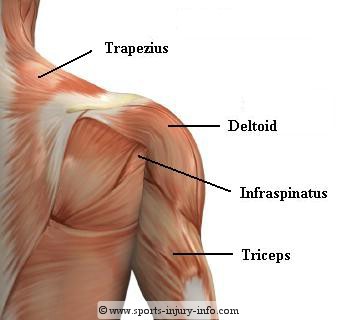
However, the shoulder area is composed of several main structures which give it a more specific form:

The spine of the scapula, to which the deltoid muscle is attached, and the trapezius muscle, which forms that diagonal shoulder line coming out of the neck. If one looks closely, there is an angle break where I drew the arrow, between the trapezius and the deltoid (link to illustrate).

This is so subtle and can easily be missed without knowing that it’s there. And once you know it’s there, you can no longer draw noodleman anymore, because you know that that curve should be broken down into more segments than 1. 🙂

The more I know anatomy, the more it will free me to be able to work from imagination and the faster I can draw and focus on more important things, like what inspires me about a subject.
I don’t mean “knowing anatomy” in the sense of memorizing every bone and muscle under the skin, but rather knowing practical anatomy – practical for artists, that is, not for doctors.


Now a bit about where I’m at with my education: I am now finishing my second year of training, after which I will have one more year to go.
I study at Georgetown Atelier in Seattle.
Next year I will be the senior student and the only one in my year, painting in full palette.
Other than me there will be two more painters in the school, which are just starting out and the rest of the students (9 of them) will be drawing.
I am a little nervous about that. Up until this point I always had more senior students to consult and learn from, but no more.
All 6 of them will be graduating in 2 weeks after 3 years of hard work.

Our graduation party showing everyone’s work, including mine, will be held at the school, on June 30th, 5-9pm.
It will have lots of art, music, refreshments, people and a really neat ” busy art studio” environment.
If you are in the area I would be happy to meet you and show you around, everyone are invited to the party and I will be very happy to see anyone who has interest in my art. Feel free to invite whoever you’d like. Here is the event on Facebook: Link. I would be delighted to see you there.

-Ifat


My finished portrait painting (weekly #10)

Friday I finished my 4-week painting. Here is a picture of it that I took with my cellphone:

(Click to Enlarge)

I’ll post a high quality picture after the painting is dry enough to varnish (which revives the color and reveals finer details).

I had fun painting this one.
Because of the subject, I felt comfortable painting more loosely than I usually do. The reason for that was that an unblended brush stroke would end up looking like a wrinkle in the skin and stay true to the subject.

This means that I did not make an effort to blend brush strokes into existing paint on the canvas and just let them sit on top. Another aspect of this is that I built up my paint in layers working wet into wet. So, suppose I wanted to paint the feather, for example, first I would put the background, then I would put the colors of the halo of the feather (I wanted it to have a bluish halo), then I put some dark brown, which is the average dark part of the feather and finally built up the lighter paints on top, letting them sit there without blending them into the canvas.

I will try to continue the same method of working on the next long pose – we will have a young woman.


I find that I really like finding similarities among objects, as much as I like finding the differences. I may think of the structural separation between the nose and the cheek, but then find that they are similar in value because the light is hitting them both equally, creating very little separation between the two planes. It is a challenge to describe the differences and the similarity at the same time. I enjoy this challenge and I am curious to see to what balance I would eventually arrive to in my style of painting.
Finding differences is more of my natural inclination and I hope the balance will end up being more on the “similarity” side.

For a reason I don’t yet know, subconsciously, I think of being “true to what I see” primarily as being able to find distinction between things rather than similarity. I think that deep down inside, I think that it is the separation from other entities that gives something its identity, even though its similarity to other entities is part of identity just the same. For example, an apple is an apple because it is different than a banana (it’s green, firm etc’), but also because it is similar to a banana (it’s sweet, edible etc’).

Or to pick an example that relates to painting: An object in a bright light is distinct from a neighboring object in the light (they have different shapes and colors), but they are similar in that they are both in the light. The question is, which should takes precedence when painting them – The similarity or the difference?

My answer is: It depends on what the theme of the piece is (I think of it as the “actual subject”, as oppose to the subject matter, which is a different thing). If these are just background objects to the “actual subject”, then it is better to describe them as just “things that have bright light hitting them” and play on their similarity. If these are the actual subject, though, it would be better to emphasize their difference.

The challenge is, then, not to obsess over any particular object and describe it to perfection if it is not the “actual subject” of your piece. This sort of obsessing is easy to do, since when painting it, it is the center of the artist visual focus (Last week I quoted my instructor about this).
I think the key to avoiding the error of over describing something is to keep in mind the actual subject of your artwork at all times. This is achieved by staying emotionally connected to what it is you find appealing in the painting you are creating at all times.

I am discussing this a little too soon, though. I am still an art student and what I create are studies, not art in the full sense. I learn to see and describe value, color, paint handling and so on. As such, they don’t necessarily have an “actual subject” – not a subject I chose and not one I am necessarily emotionally attached to. This is OK, this is the way a school should work, in my opinion, since the primary focus should be technical.

Next year, which will be my final year, I plan to work on a project that would involve more of working from imagination and putting a figure in an environment. That project will be one where I will apply the above thinking more.

Have a good week and I appreciate your interest,

-Ifat


Painting and Abstracting (weekly #9)

Progress with my painting: 2 weeks ago I posted a drawing and the study of the painting I’m working on now at my school. Friday I took a picture of it with my cellphone. This picture is unfortunately not true to color, please take that under account when viewing.

This week’s plan: Work on the shirt and vest, finish the hat, the background, and do final touches on the face and neck.
This picture shows the “sinking in” phenomenon very well. It’s a phenomenon where the oil pigments appear lighter than they are and in a different color. The vest, for example, appears black-gray even though it is brown in real life. This is why it is important to cover the painting with a thin layer of oil before working back into it to revive the color and see it correctly. This process also has its own difficulties; for example, if the paint is not thoroughly dry, the oil may lift it up, it may even get smeared into new areas and make the painting “muddy”. It’s therefore very important to be in control of the painting and know exactly what parts are wet and what parts are dry.

Abstractions.

One thing I thought of is that the skill of figure drawing involves abstracting things about the figure and then using those abstractions as a guide when drawing or painting. The abstractions can take a literal form, such as: “the eyes are located in the halfway point of the head”, or a more perceptual form, such as remembering the general shape of the eye socket.
I’ve been doing a lot of this process of abstraction, which I exercise at home sometimes by sculpting or sketching from my head. Here is one small plasteline-clay sculpture I did this weekend:

I don’t know why, but I find that the pleasure in working entirely from my head is not surpassed by any other process of making art. I realize that the result is not as good as working from a reference, but I wish I knew what causes this feeling of delight and how I can replicate it when working from a reference.

I think it is really important as an artist to let your emotions run the show. I don’t quite know how to explain what I mean perfectly; I am not talking about any sort of random emotion that comes up during work (that can actually be an obstacle), but rather about the feelings relating to the artist’s subject matter. Some parts of the subject matter are bound to carry more interest than others for the artist. I think it’s OK to be bored with some aspects of the painting and let that affect how you paint. In fact this is what produces a good painting in my opinion because it replicates that feeling the artist had about what he paints in the viewer’s mind. It enhances the parts that are interesting and central about the piece and sends to the background the things that are not. It is, perhaps, the closest a person can get to experiencing something through another person’s mind.

Lastly, I’d like to share a small piece of writing by my teacher, Tenaya Sims, which I found interesting and which relates to “seeing through someone else’s eyes”. This is from the latest Newsletter of Georgetown Atelier (where I study).

The basic idea is if you approach painting your shadows in a thin/transparent manner, while building the textural qualities in the lights,  it will increase the depth and three-dimensionality of your painting. Executing shadows in this way helps keep them more atmospheric and ‘shadowy’, and pushes them back into the depths of the painting.  People naturally focus on one area at a time when looking at anything, and usually look first at the illuminated forms rather than those in shadow. Everything not in our focus is more hazy, or by definition is ‘out of focus’. For this reason it’s more effective to simulate the way people see in our paintings than to render each passage equally in focus. Putting in too much information in the shadows, or painting them too thickly (resulting in the surface of the painting coming forward) can negate the effect of how we naturally see. On the other hand, building up the texture and opacity in the lights, or ‘sculpting the lights with paint’ as I like to say, helps to enhance the focal areas of the painting and brings them both literally and perceptually forward to the viewer.

Simulating the ‘way that we see’ in a painting is much more difficult than it sounds. This is simply because while we’re working on any one particular area, that area is in focus for us, but may not be for the viewer taking in the whole scene of the painting on first glance. It requires us to plan out the ‘global relationships’ of our painting, and remember to stick to that global plan even while working in specific ‘micro’ areas. It requires us to be both the General and Marine, or in other tems, know how our ‘shadowy village’ fits within its country.

This method of simulating the human way of experiencing what we see in a painting is a way to further refine an experience and bring it closer to how we experience it as conceptual beings rather than raw sensations (which is closer to what a camera sees). It’s a little bit like a double filter: seeing something after someone else saw it for you first.


I’ll end the post here.
Have a good week,
-Ifat