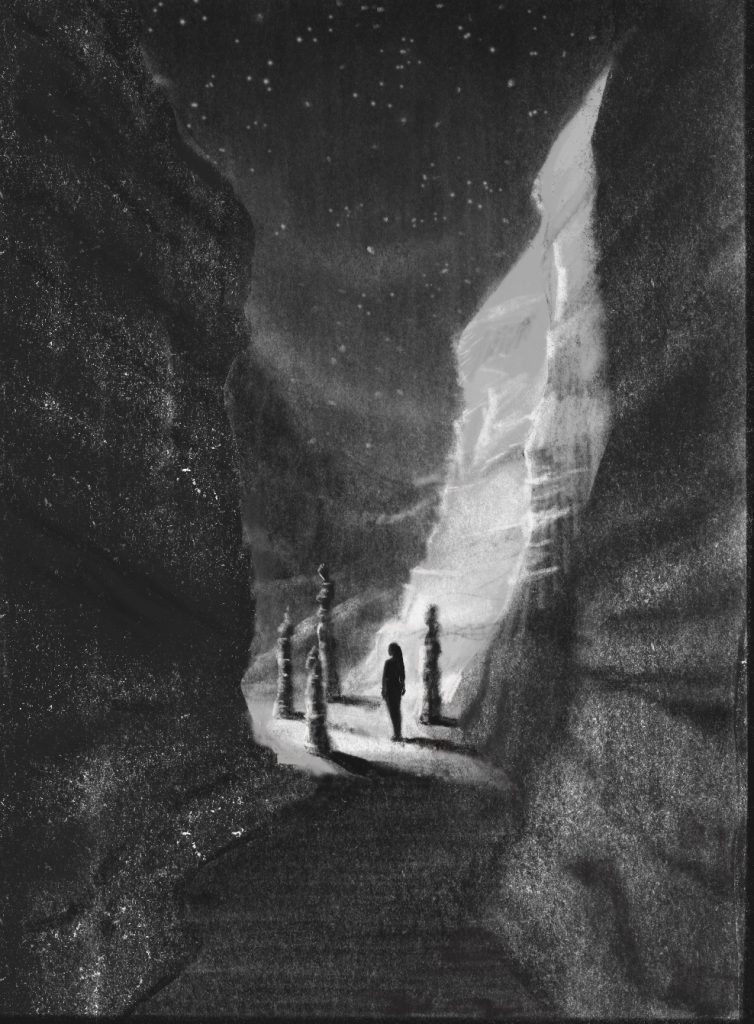
Ritual
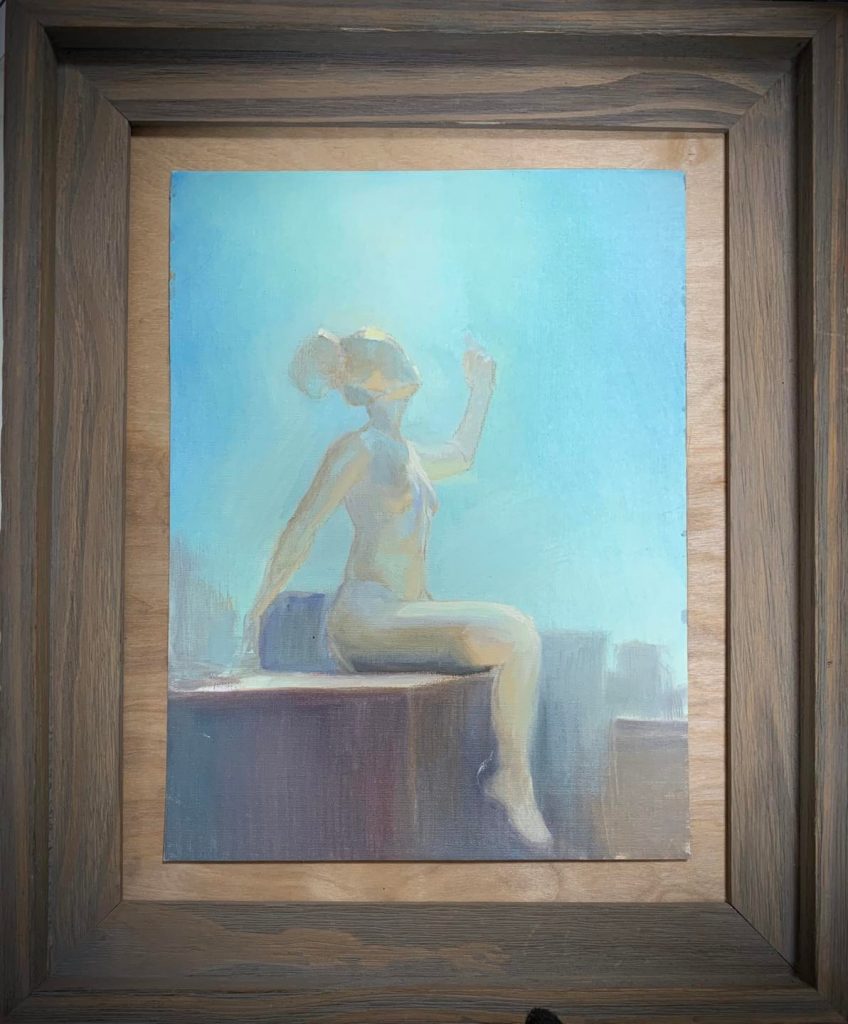
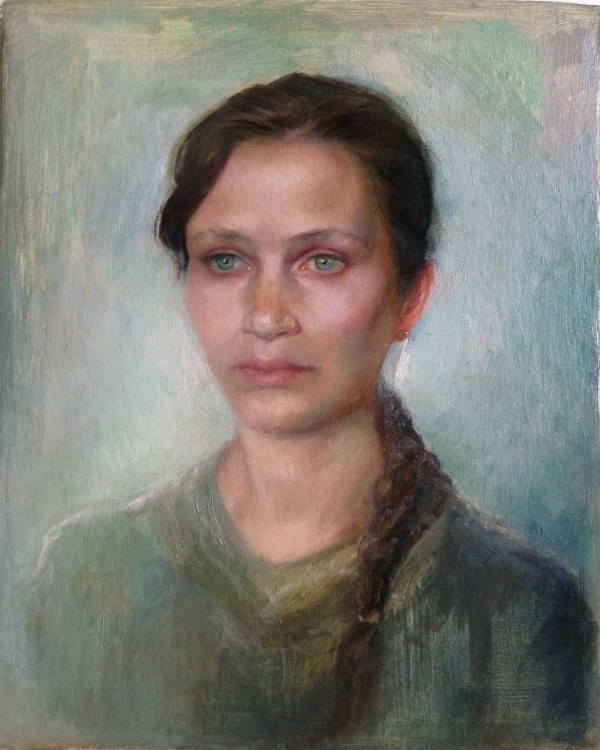

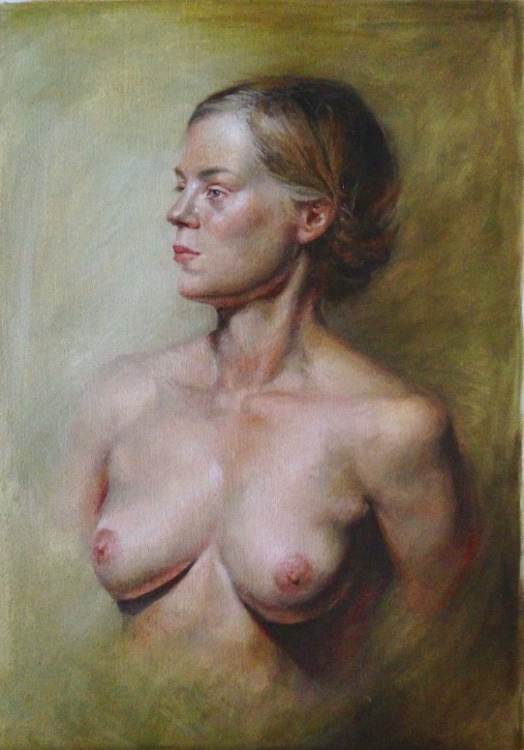
This painting was completed in June 2014 and I wanted to present it with some of its earlier stages and thoughts while I was painting it.
It started when my friend came for a visit and graciously agreed to sit for a portrait.
I set up and started painting from observation that day when she was posing for me. I later finished the portrait from her photo.
Here is how it started:

My medium was half linseed oil half mineral spirit. The mineral spirit dilutes the paint and oil and breaks the paint’s bonds, making the pigment flow similar to a watercolor and the oil keeps the pigment flowing and glossy and bonds it to the canvas. I really enjoy starting out with translucent paint and then building up paint on top of it.
I selectively rendered some parts more than others and left others simplified and flat. The idea was to create visual contrast between the rendering style of different parts thus drawing attention to the part I was most interested in, which is her eyes.
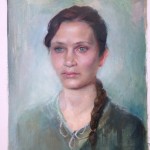
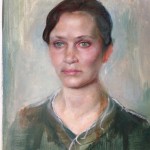
Throughout the painting process her portrait acquired a variety of subtle variations in expression. Here are some photos

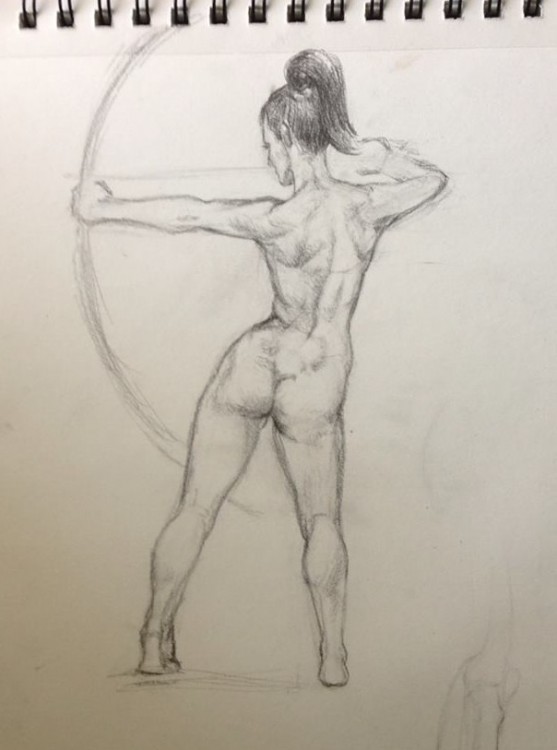
8”X11” Graphite on Paper. I named this one ‘Dancing through Fire’. I started it while listening to the lyrics of a song I heard on the radio earlier that day. It was a pop song about self-empowerment, but the visual image of a dancer dancing amidst flames ignited my imagination and I grabbed my sketchbook and drew a sketch of how such figure might be.
Her body posture must reflect the nature of the flames; a wild, selfish, free force reaching up for oxygen but grounded to the ground where it begins.
It needed to be uninhibited and in full force of motion.
When I was done with the figure I added shackles, which I did not initially have in mind. The pose seemed powerful and she needed to be grounded, like the flames. A powerful force ignoring its external bonds.
It stands in my mind as a symbol of life amidst difficulties; a dance as a response to shackles, saying that one’s spirit cannot be bound.
I started with the gesture, then general volumes, then anatomy and lastly all the values (the lights and darks) had to be figured out. That was the most challenging part, to imagine a light source and how this light source would influence a figure, how to arrange it all to make the figure stand out and still allow it to have dimensionality (rather than being 2 dimensional).
It was a difficult mental exercise but satisfying nonetheless.
Anatomy has been a delightful pursuit for the last year since my graduation from Georgetown Atelier.
I am so enamoured with it; the human body, the biological machine, an absolute beauty; sophisticated and elegant, powerful and capable of executing our will as well as express our emotions. As social beings our bodies and minds have tremendous power to communicate and perceive our mood and character.
Every artist who studies anatomy does it for a slightly different reason, I believe. Continue reading

I had a fun day going out drawing with my new watercolor sticks and a black fountain pen, sitting in the street on the sidewalk and drawing trees.
It was a fun to walk going around “hunting” for a special tree I find appealing and a way to experience an otherwise somewhat familiar neighborhood through new eyes of adventure.
What sent me on this trip to begin with was my interest in harmony of lines, in patterns – and plants are the perfect subject matter for that.
They have the same blueprint yet every leaf and branch grows differently according to its surrounding, and together they form a structure that has similar patterns and sense of movement, yet the branches and leafs are different from one another, and each plant has a different pattern than the rest. It’s random yet structured. I find them really pretty.


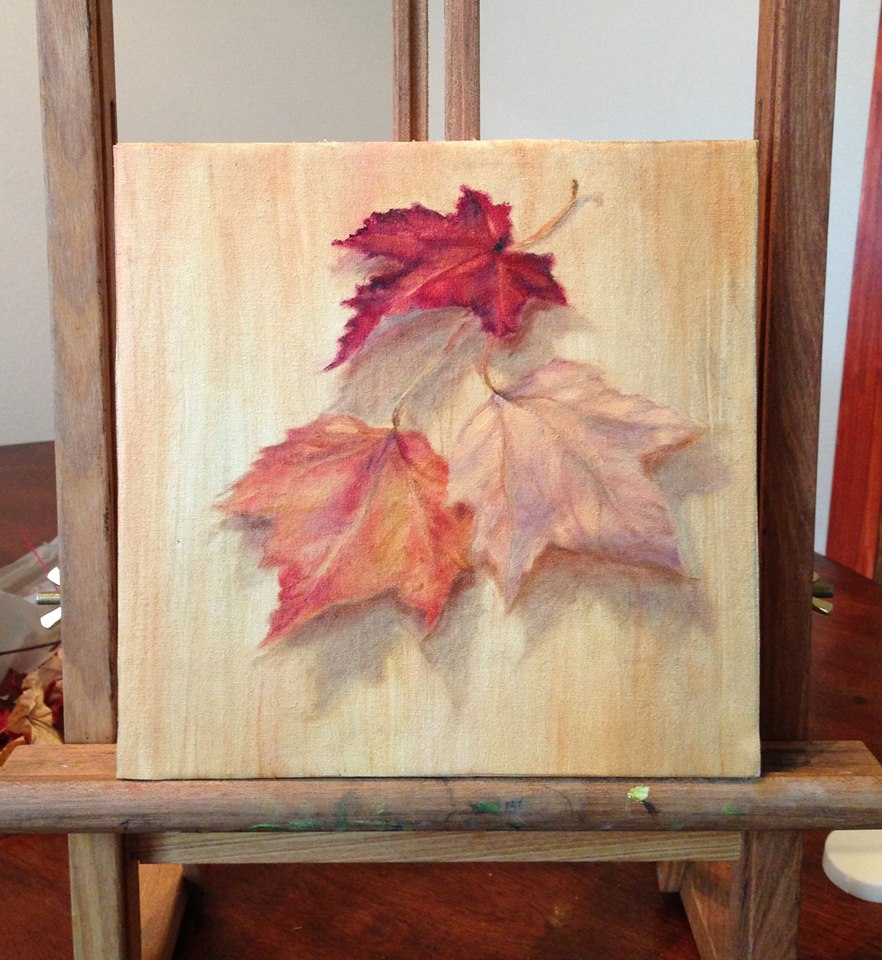
I did this small study of leaves for an art event this month.
I really enjoyed trying out something new; I use mineral spirit as a medium without using any oil or gel to make the paint flow. The result is that the paint becomes much like watercolor while still allowing thicker areas where mineral spirit is not used.
The nice thing about this is that it is possible to get very bright and very chromatic at the same time Continue reading
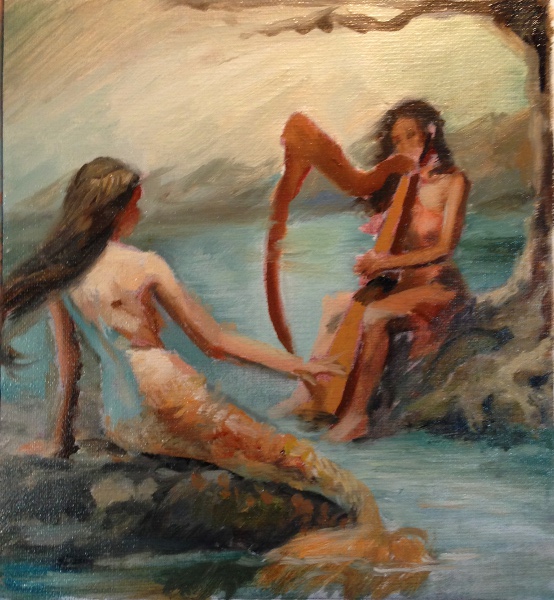
I am currently busy with 4 paintings, which I am trying to finish in time for my graduation from Georgetown Atelier in 4 weeks.
Indeed. I will be done with atelier education. Caplawza! For lack of a better word.
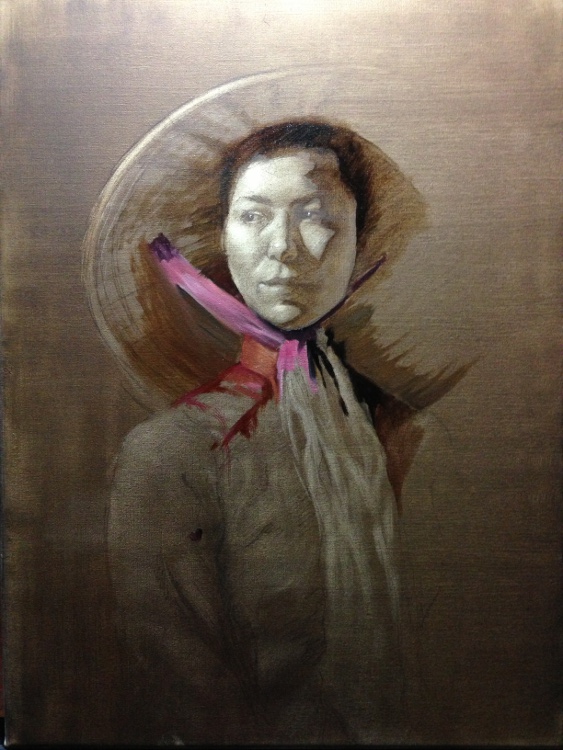
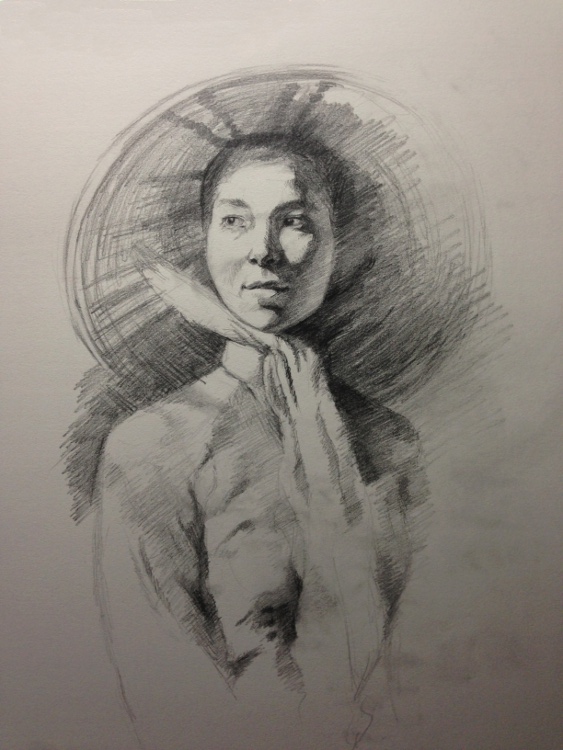
Here are the beginning stages of one of the paintings. It started with a little tiny drawing for the concept:

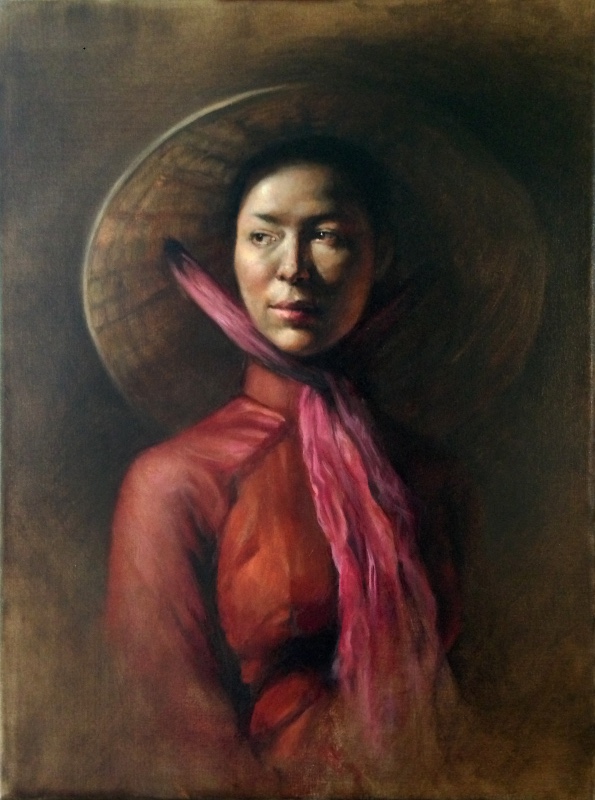
That picture and this painting of her face share the exact same principle as in this Georgetown Atelier Tutorial, which was really fun to discover.
The key is that the darkest dark is in the cast shadow. In the sphere it is the shadow right under the sphere. The core shadow is second in degree of darkness and lastly is the dark side filled with reflected light. The light on the model’s face was exactly the same. If you examine the picture bellow, look in the groove of the chin, under the top lip, right under the nose, and right under her eye in the dark side: Those are all the darkest dark. Second in degree is the core shadow, which is slightly less dark (like on her cheek), and the reflected light, which is significantly lighter here than the other shadow areas.
Seeing this principle clearly allowed me to paint with greater clarity, and better yet, I will be looking for the same principle next time I paint and every time I paint.



-Ifat
Some paintings from this year I didn’t have a chance to post yet. I painted these as part of my education at Georgetown Atelier. Both painted from a live model.
On the left is a 5 day painting. It’s 16”X18”, oil on Linen.
On the right: A 2 weeks painting, 16”X20”, oil on Board, named ‘A Question’.


-Ifat
I’ve prepared several studies for it trying to decide what exactly I want to paint and how to crop it. I spent several hours cropping, re-cropping, painting and repainting this small figure until I made up my mind.


Today I’ve transferred and fixed it onto a canvas, did an underpainting (which is a single-color, transparent painting which helps guide the placement of the main layer of paint). Tomorrow and next week I’ll do the painting itself.
-Ifat
 ‘
‘
‘Looking Forward’, 17”x24.5” oil on Board
Here is the study I did for this painting (minus the last few brush strokes to finish it):

The model I was painting was a beautiful woman in her 50’s. I decided it would be a good challenge to paint her younger because it would force me to understand how the light interacts with her flesh. It wasn’t easy and if anything, it was a good reminder of the need to further study the anatomy of the head. As usual, trying to draw from imagination is the best way to realize how well you have the form conceptualized (or not!).
It was interesting, and I appreciate how the model brought this mood and attitude with her to her sitting sessions (most notably at first! before it started being boring and uncomfortable I’m sure).
This painting got me thinking of just how much of myself I bring into a painting vs. how much it is about capturing the model.
I think nowadays (or maybe always!) it is considered graceful to focus on capturing the essence of the model who is sitting for the artist. Paintings are usually named after the sitter, as well. But for me, I always make it about myself and how I feel – even when it is a male model. It is a human being, and that is enough for me to relate to their experience.
I feel like when I re-create them on my canvas that figure exists in a different universe. And I capture how they feel while in that world. It’s almost like writing a story in the third person… Often this form of writing makes the writer relate to the characters more personally than if they wrote it in first person form.