How Tools influence our Thinking

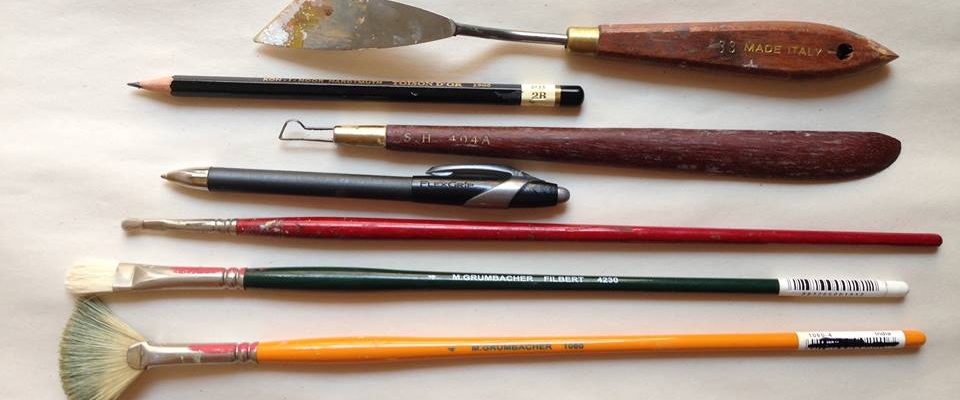
Art Tools

A thought about tools and painting: The tools we hold actually change our thinking. A tool determines what can and can’t be done, what solutions and options are open to us or not.

Our subconscious looks for solutions based on the options our tool provides. If the size or shape of your brush is not the one that matches what you envision should happen on your canvas, then you will probably get something that doesn’t exactly match your vision. Same thing for the paints you use or how the surface of the painting is like.

Like trying to do a block-in with paint on a very absorbent surface. The brush doesn’t want to move and it’s hard to draw. It can change the way you do your block-in. The drawing may come out more segmented, for example.

Or how about trying to create bright chroma with a muddy pile of paint?Trying to create large shapes with a small brush. Trying to create straight edges using a rounded brush. So my conclusion is that it’s nice to incorporate the habit of spending a minute to choose the right tool before I start working.

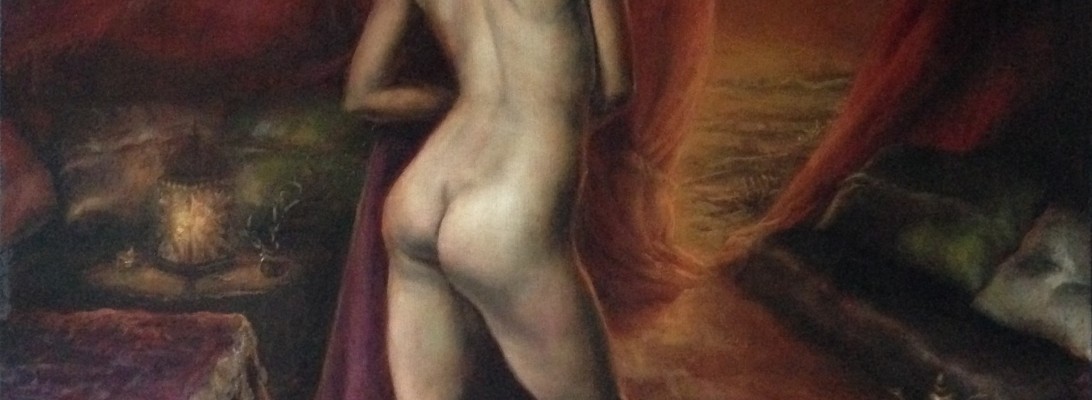
‘Glimpse of the Desert’; Oil painting from start to finish

It started with a square canvas which I built from wood. One of the first panels I ever made. It was the summer vacation in my Art school in Seattle and some of the students hired a model to pose for us for a long pose. 6 hours a day for 4 days.

I brought the canvas with me not knowing what the pose will be. When I finished the painting, working from life, it had an abstract background. I placed the figure in the center and I had no idea of what environment she might belong to.

Kat

I was really inspired by the pose but I felt that an abstract background did not fit it at all. A few months later, I realized what the right background for this figure is: It needed to be the inside of a tent, overlooking the desert at sunset, because the woman reminded me of some kind of Arabian royalty. The pose was very organic, and communicated confidence and relaxation at the same time. I imagined her being on a journey of some kind, and being royalty, the tent would naturally be luxurious and private.

So I decided to take the pose from the 4 walls of an art studio into a setting closer to a fancy bedouin tent. Having been in those a few times in Israel in the Negev desert, and getting a glimpse of that very simple, slow lifestyle, I wanted to paint something with that warm, slow atmosphere, something that adjusts itself to the pace of the desert where life moves slowly at the end of the day.

That new aspiration presented a challenge, because I had to invent the background and have it match the studio light – the light under which the model was standing.  At that point I started searching for references for different bedouin tent elements online. I tried to get an idea of how a fancy Bedouin tent might look like and what kind of items would be in it. I used photoshop to try to arrange them together to get an idea of an environment. After a while of doing that I realized the complexity of the scene requires a much more realistic model to paint from, if I wanted the background to match the degree of detail of the figure.
I went to a craft store, where I shopped around for a few hours, gathering items and getting ideas. When I left the store I had almost everything I needed and I sat down to build the tent.

I made a tiny little sculpture of the women to “calibrate” the light. Used a clamp-on book light to replace the studio light and used a candle for a lantern. Overall there were 3 light sources in the painting.

Tent Setup

I sewed the little pillows from various fabrics I bought wrapped around tiny pieces of sponge. I made the tent by sticking some wooden sticks into a corkscrew board. It was like building a tiny dollhouse.

I did a small value study to try to figure out the composition.

Once I had the tent, I was ready to paint. The first step was to do a perspective drawing. The strange thing is that here, I had to decide what the eye level is rather than it being decided for me, because I had to identify the original eye level according to the rendering of the figure.

Fast forward, I finished the background.

Lastly, I decided I had to change the direction of her head because to me, the meaning of the painting and the moment was in having this woman look outside, to the last remnant of light on the desert sand. So I drew a little diagram of the new angle:
Head_700px

Then, because I couldn’t have the original model posing for me again with the original light (though believe me, I have dreamt of it!!), I recreated the new angle based on the colors and values of the painting combined with this drawing (which was drawn with the aid of pictures). A note to myself was to always take notes of what colors I used in my paintings so that I can easily go back to them if needed.
Here is the study for the head. It involved a lot of interpolation since I did not have a model to paint from.
Head Study

Lastly I needed to seam the edges of the figure with the new background and to add hints of light to match the new environment. Add little objects, like the teapot and the carpet, a little thorn to decorate the table.

It was a difficult painting but I gave this lady the environment she belongs to, as I saw it and now the painting is complete. 🙂
‘Glimpse of the Desert’, 23”x24”, oil painting on board.


Pose Balance

Having a grasp of general principles of balance allows an artist to draw figures better; to create a sense of stability, dynamic stability or a sense of someone about to fall over. Those are created by how the body’s position relates to the frame of balance. Poses can be classified in their relation to balance as: passive stable, active stable (holding an arabesque), dynamic unstable (mid-motion), passive and dynamic (you’ve fainted  and your body is falling through Alice’s rabbit hole).

Considering different poses got me thinking about balance from a predominantly mechanical point of view rather than an artistic one and that’s the thinking that I’m detailing in this post.

The first principle to consider about active, stable poses  is that our two feet (or whatever other body part touching the ground) create a stable structure, much like a table’s legs, on which the rest of the body can move and shift.

The metaphor of the table still holds true on one foot, because each of our feet is like a small tripod with three points of contact.

This is important because a table can balance weight in different distributions, like so:
balance
And a human being balances different weight distributions on top of our legs in the same way:
balance_figure
The center of gravity of the stick figure on the right is further shifted to the right, but the two legs are able to carry the same weight just the same.

Legs can carry unequally distributed weight up to a certain point. Put the ball too far on the edge of the table and the table will fall sideways. Place your center of gravity too far extended in relation to your legs and you’ll fall.
But within a certain range, a variety of poses are possible with the same leg position.

It also works while standing on one foot because each foot is like a small tripod. A small tripod can balance a small area of weight distribution over it (or a small surface on which objects can be safely placed without toppling the table over to use that metaphor).
balance_one leg

The bigger the surface area in contact with the ground the more stability is created and more room is created for “imbalance” on the table’s surface. A more elaborate base can be created by kneeling, standing on the hands, laying, sitting etc’. The more surface is in contact with the ground the more stable the base of the table is and the more room there is for shifting weight on the surface.
That means that there is no single “solution”, no single way in which the body must be positioned in order to be stable, given a certain placement of your two feet. You can balance a variety of positions with the same feet placement, similar to how you can place a heavy ball on the surface of a table in different distances from the center and it still remains steady.

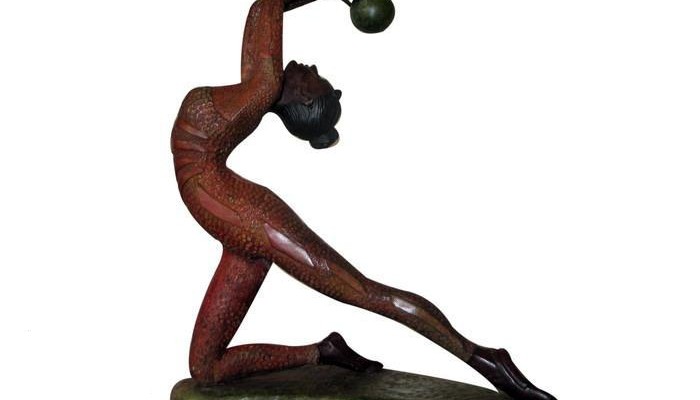
To illustrate; imagine this dancer, who is leaning back, slowly straightening out her torso and then leaning it forward with her arms reaching forward. She will still stay stable, with her legs in the same position as she does this, until the point when her base will no longer be able to support the strain of the imbalanced weight. (Little note: This sculpture is decor art sold by a manufacturer called  bronze dancer figurine)
sculpture_kneeling_ballet_strong_style_color_b82220_dancer_strong

So far so good, but this completely neglects to mention that dynamic, stable poses are usually comfortably balanced. Stable poses on the verge of collapse are pretty unusual in art or in life drawing sessions, even though they are physically possible.

In a more classical figure drawing approach Ballance is carefully sought. The wise reasoning Andrew Loomis provides is:

“Balance is a physical attribute each of us must possess. If a figure is drawn without balance, it irritates us subconsciously. Our instinct is to set firmly on its base anything that is wobbling and likely to fall. Watch how quickly a mother’s hand grasps the teetering child. The observer recognizes quickly that a drawing is out of balance, and his inability to do anything about it sets up a negative response. Balance is an equalized distribution of weight in the figure as in anything else. If we lean over to one side, an arm or a leg is extended on the opposite side to compensate for the unequal distribution of weight over the foot or two feet that are the central point of division for the line of balance. If we stand on one foot, the weight must be distributed much as it is in a spinning top.”

Our body will naturally seek to minimize effort and that’s why balance is usually maximized in static poses. However, one foot is not exactly like a spinning top. It is a bit more like the 3 legs of a table; not by much, but by a little, perhaps barely enough to see difference, but a difference is there which is why we can create poses that are on the verge of being unstable but can still be held statically.

You may have heard it many times before that the way a contrapposto pose is balanced is by having different body parts lean in opposite directions to balance out the center of gravity and that the resulting center of gravity is placed above the weight bearing leg. So you may ask yourself; “if our feet can balance a variety of poses is it necessary for the different body parts to move opposite to one another or for the center of gravity to be placed above the weight bearing leg/ center of stability?” In my opinion the answer is no, they don’t 100% have to, but usually they will and it will happen naturally. For example, you think of extending your arms and torso forward and immediately your pelvis and legs will move in the opposite direction over your center of stability to balance the weight.
This is the case in these beautiful illustrations by George Bridgman:
Bridgman_Balance
This allows you to extend further sideways than if your legs and pelvis remained straight, and it reduces the load on your muscles. This compensation happens naturally. That leads the discussion to the last and important piece of the puzzle; the muscles.

Our muscles kick into action whenever we wish to hold a body part against gravity. lean forward and your back muscles have to work to keep you from falling forward. Lean backwards and your abdomen muscles have to work to keep you from falling backwards.
abdomen_exercise

They operate in a more complex way than that, but in basic terms, your muscles kick in when you wish to hold a pose against gravity. They are there to serve as a glue that keeps your body parts from falling over. The more unstable the pose, the harder your muscles have to work to maintain it.

Dynamic stable poses can require a lot of muscle activity. Imagine a dancer’s arabesque, for example; Lots of muscle groups work to keep different body parts mid-air against gravity.  So long as the muscle are able to keep working, the pose remains stable.

So to conclude, to think of figure drawing in terms of balance is to first get a grasp of the base of stability of a pose, and try to imagine what sort of range of imbalance it can hold over it (what size of “table surface” can such a base hold). Then, figure out how far out the “ball is placed on the surface of the table” in that pose. Is it an extreme pose on the verge of imbalance? Maybe it is a classically balanced dynamic pose (which it almost always will be).
Some poses are like moving a weight to the edge of the table, instead of comfortably placing it in the center of the table. It is fun to think of poses primarily in terms of their balance and thinking about it in those terms might help get the mood of a pose across.

The many forms of visual CONTRAST

Midsummer Eve, Edward Robert Hughes, 1908

Visual contrast is a key concept in the making of an artwork. A concept I learned from online lectures by artist Bill Perkins at NMA.

My initial concept of visual contrast was very limited. I thought that contrast consists of something visually standing out due to being darker or lighter than what’s next to it. I was aware that you could create color contrast. But his lecture really opened my eyes to the endless forms of visual contrast that take part in an artwork and shape the way we experience it.  Continue reading

Value in composition

Values is a term in art that describes how light or dark something is. It refers to the grayscale value of a color.

How light or dark something is is one of the primary ways our visual system analyzes the visual world around us. It’s how we recognize something as a shape or an outline and it clues us to understand it as an entity.

In visual art it is a primary tool to emphasize and de-emphasize elements in a work of art. More specifically than value, it is the contrast that is used to make something stand out or disappear. When you start paying attention to how it is used in art, some of those lovely paintings and the way they were composed starts seeming very deliberate and not so random. It is not just that an artist gets an inspiration and an idea of what they want to paint, it is also that they then spend time composing the values of the picture to make the theme or subject of their painting stand out. So much so that in some cases it can almost seem shamelessly composed, yet seem entirely coincidental, unintended and realistic. Continue reading

Passion for Anatomy

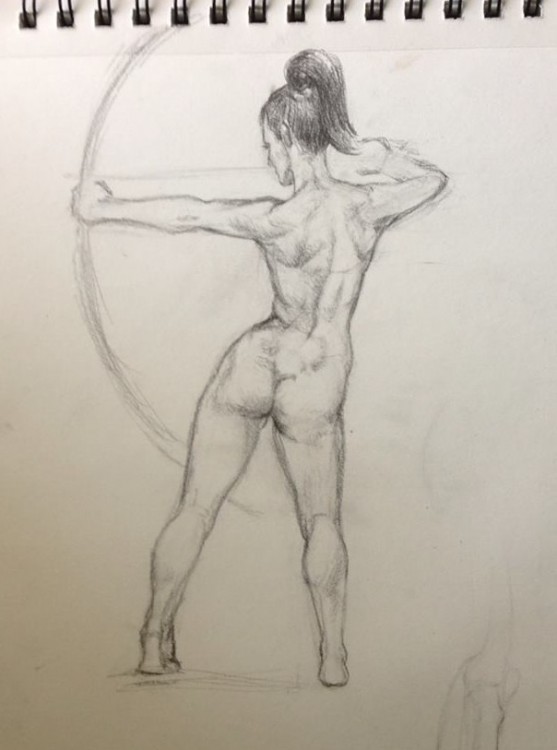
Archer

Anatomy has been a delightful pursuit for the last year since my graduation from Georgetown Atelier.

I am so enamoured with it; the human body, the biological machine, an absolute beauty; sophisticated and elegant, powerful and capable of executing our will as well as express our emotions. As social beings our bodies and minds have tremendous power to communicate and perceive our mood and character.

Every artist who studies anatomy does it for a slightly different reason, I believe. Continue reading

Study of Local values

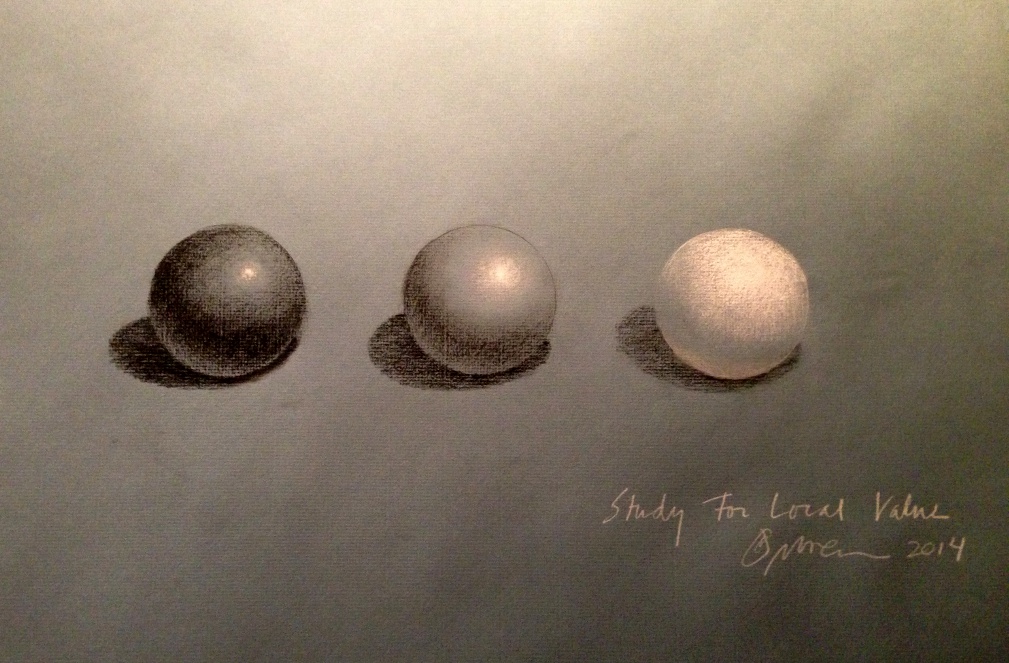
I came across this excellent local-value study by teaching artist Melissa Weinman (website).

She drew 3 balls which she colored white, gray and black with acrylic paint, placing them under the exact same lighting conditions. The image bellow was the result.

The most important and interesting deductive use I found for this is for skin values in people and how different colored-skin individuals would appear under the same light. Continue reading

Visual Principles vs. sheer Observation in Art making

Figure Construction As an art student you will often hear the idea that the artist must learn to ignore what “they think they see” about their subject matter in order to actually see it as it is. That in our mind, there is an abstract visual symbol of different things (such as the shape of the head) and that we need to learn to ignore it in order to observe what is actually there.

There is some truth to that, and some falsehood as well.

As humans, there is only so much information we can hold in our mind at any given point. Principles and generalization help us to quickly understand a situation rather than analyze it as if we are encountering everything about it for the very first time. Continue reading

Thoughts about the Painting process

Painting the figure is complex. There are a lot of things that need to be taken under account, such as proportion, anatomy, value, color – not to mention the gesture and expression and how each part of the painting relates to the whole.

The more complexity the artist can retain at any given time, the better off the painting will be, because the more factors would be calculated into each brush stroke. However, in reality, doing all of it at once is too daunting a task. It gets easier with experience, since more and more knowledge becomes automatized, but still, a lot of complexity remains anyway.

So, the artist must come up with a method of reducing that complexity into manageable steps. Traditionally, this is usually achieved by doing a block-in (a simplified drawing of the major lines and value shapes), then painting a light, transparent, monochromatic version of the subject, to figure out the value scale of everything and then finally adding the color.

This way, every aspect of the complexity is dealt with one at a time. In what’s called Ala-Prima painting, everything has to be done at the same time more or less. The accuracy of the drawing, the values, colors and the integration of every part of the painting around its theme or focal point.
However, even in doing this there are ways to reduce the complexity and dealing with it one thing at a time. Different people would prioritize what to “solve” first differently. This realization struck me clearly as I saw a picture of the following painting by Morgan Weistling in mid-stage of making it:

Look at the girl’s left hand, the one not fully painted yet. This, for me, was the giveaway. The interesting thing here is what the artist prioritized – what complexity he chose to target first. In this case, it wasn’t the structure; it was the color and value relationship. As you can see, the hand is still lacking its structure – there are no knuckles, the fingers are not yet separated and the exact outline formed by each finger is not yet accurately described. From this general paint blob, he will later carve out, or add, the structure.
Another thing that was being solved there was the proportion and the general shape. The artist was able to do that because, after years of drawing experience, those things come easily and are well automatized.

With most artists, I believe, the drawing aspect is the one issue that needs to be solved first, because it holds the most complexity, and everything else is then built on top and in relation to that initial stage. (That is the case with me with most paintings, with some exceptions).

I think that there can be two approaches here: One is to first put down the easiest thing to solve, what one already has automatized, and then build the complexity and other aspects on top of that. Or the other approach is to first start with the most complex part, get it out the way and then build the other things on top.
It is much easier, in my opinion, to use the second method, because without it, an artist can get a sense of being overwhelmed with the complexity, which isn’t made a lot better simply because something like the value or colors have been figured out. However, I think it makes for a better painting or drawing when the value is prioritized first, and the structure emerges from it rather than the other way around.

Velasquez is an excellent example of this. He has the structure well automatized that he is able to put it last, not first, and since his primary focus is value and color, he can imply the structure in a subtle yet accurate way, just enough to get the idea across, without describing everything in detail. It gives the viewer a sense of epistemological power; a sense of being able to mentally hold complexity in a simplified form; a sense of control over complexity.

Value, in a work of art, is the primary tool for unification and differentiation. It can be used to sharpen differences between objects of to unify them and send them to the background. Both are important in a work of art, because art described things in a selective way – it enhances the central aspects of a painting and de-emphasizes the ones that serve merely as context or setting for the main focus.

Incidentally, while I admire the painting style of the first artist I shared here by Morgan Weistling, I think he utilizes the same style all over the painting non-selectively. A lot of artists do that, with different styles (it can also be done with photo realism). Compare that to this painting by Ilya Repin, a Russian painter from the 1850’s – notice how the ships in the background are mushed together in value and lack detail to de-emphasize them and send them to the background, while the men are described much more and appear to emerge. I think this selectivity of rendering makes for a superior art work.
Therefore, I think it is wise to start a painting with the values figured out, and then have the structure emerge out of that, slowly and in a controlled way, creating the emphasis only where the artist needs it to be.
The problem here is that it is more difficult to describe (or what I call “solve” or “figure out”) the structure rather than the value, and so if all your canvas has is the general values, the entire complexity of the drawing needs to be solved as you go. Ouch!
I think a solution to that is the wipe-out process, which retains some information of the drawing while still unifying the values across the entire painting.

Anyhow, I don’t feel like I’ve reached a definite conclusion, but rather made some interesting observations about how an artist approaches a painting and deals with its complexity.

I think in most cases, the artist will first solve what is most difficult and what takes up most of their mental space. This changes over time once some aspects become more automatized compared to others (these are usually what the artist is most fascinated with).

I’ll have to continue this line of thinking some other time!

Merry Christmas!

-Ifat

Recent paintings and thoughts about modern Art (Weekly #24)

Long time no see, Blog. Don’t ask, I’ve been sick for a week and had a lot of other stuff going on, but I’m back, ready to provide you with some fresh content.

First is the painting I did at my Atelier last week, working from a live model for 5 days. This was done in 4 colors: Redish brown, Yellow, Black and White.

I would get cool tones from mixing black and white to make a gray, or from mixing black and yellow to create a green, warming it up with red as necessary.
I was able to achieve a peach-brown by mixing my brown with white, or leaning more toward an orange by mixing it with the yellow, neutralizing it as necessary with the black and white. Wooha!

I also started working with a new palette which I absolutely love. It’s a glass palette. The neat thing about it is that I can control the background color against which I mix my colors, which allows me to see what I’m mixing so much better.

I decided that from now on I will start using a paper color that matches the average color of the skin tone of the model in the light.  It really helps.

Here is the painting, done over 5 sittings of 3 hours each.

One of the things I learned here was how to solve the problem of cropping a figure against an abstract background. In this case, for example, I wanted to emphasize the triangle shape his arms created and end the painting there without painting the lower body part. The reason for this is that I felt that the core of the pose for me was the strength created by the two joined arms and that it was framing the body nicely. I liked the strength of it.

But then the problem was how to get rid of the rest of the body mass without making it looked chopped off. At first I simply didn’t paint it, which gave it a lovely Cheshire cat look, where one sees only the head of the cat. As lovely as that was, I decided against it. And painting carelessly and mostly using my subconscious the idea came to me to paint the beginning of the other parts in the right value, but with the background color instead of the flesh tones. This allowed me to then dissolve it at will into the background without making it feel like a strange operation was involved.

If you’re not an artist, this might bore you to death. And it might still bore you to death even if you are an artist, I don’t know. But it doesn’t bore me! Which is why I keep talking about it. 🙂
But anyway, indeed, it’s time to move on.


I also painted a few still life paintings. I am painting them quickly, one every day or two, with the purpose to practice and learn paint handling. Here is the result:


My next project is going to be a group of glass objects. It’s going to be longer than these studies – a 2 week project or so.

My next figurative project is going to be 2 weeks long, working from a live model again – a male model. I don’t know what the pose will be because I have no control over it. I will choose the angle and how I render it, but that’s about it. I hope it will be something I like.


I actually have a lot of thoughts about art and about my art, but they have not grown deep enough roots yet in my mind to articulate or write about.

I find that usually when I have an idea, it is not isolated – it is part of a generalization which relates to other areas of my life, and the process of forming the generalization and making the connections takes time and thinking which spans over years sometimes.

I was thinking about what art IS. I believe if you ask someone who has been through art school they will tell you that everything can be made into art.
If you asked what a spoon is and someone told you that a spoon could be anything and everything you would think they are nuts. Why? Because a spoon is a specific object, with a specific shape-family and function.
But the same does not apply to art. Why? Because the identity of art involves a high level abstraction. Forming the concept of what art IS involves identifying a lot of abstract qualities about art. In our modern age where people are taught not to trust their own mind, performing this level of abstraction on our own is extremely difficult, borderline impossible.

Similarly, the question “what is a spoon” is much easier than “what is justice?”. The later involves a chain of abstract concepts which need to be retained and which have no immediate physical manifestation. You don’t “see” justice in the street the way you might see a spoon.
The essence of “justice” is hidden in actions, in seeing similarity and relating them to one’s existing spiritual values. It’s harder to do.


In the last decade there has been a resurgence of classical realism. In the last 10 years over a dozen ateliers have opened across the United States and Europe where none existed earlier on. The only option for artists seeking training was an art degree, which was a pile of wishy washy intellectual crap without a single course offered as a saving grace to develop actual rendering skills. Pretty much, that was it.
The leading premise was that to teach an artist anything concrete would be to destroy their artistic freedom and identity – to make them into a mold. But actually, what this idea mean is that to have an identity means to lose freedom. In fact, if something has no identity, it does not exist.

We are conceptual beings, but to form those concepts and concretize them we need a visualization of them. Something like “Pride” may only be understood when seen on a human face or through some action (like soldiers, going to war). There is an inseparable connection between the tangible and the abstract. Take away the tangible and you “art” is a pile of materials. It is no longer ART. It’s a piece of no good junk. (OK, I may be going overboard here, but I couldn’t resist. I just love calling things a piece of no good junk, especially in a southern accent for added emphasis). It’s true of most of them anyway, if not all. I wouldn’t know because I find them too boring to pay attention to.

Believe it or not, I got my share of hate for my belief. As if that’s gonna stop me. If you want someone who supports modern art you only have the rest of the world to talk to. Don’t take your insecurities in your opinion out on me.   You don’t see me torturing you because of what you believe, right? That’s because I am confident I am right.

Anyway now that this issue has been settled, I’d like to talk some more about something else on my mind.

As my “About” page mentions, I model in order to pay my tuition and living expenses. (By the way, buying any small piece of art off my hands would be SO appreciated).
I’ve had some thoughts about modeling. I absolutely love doing it. It involves standing still in a pose or several poses while a room full of people creates art based off of you.
I realized that what I enjoy about it resembles very much my motivation in making art.
When I am motivated to draw, paint or sculpt, the subconscious, underlying motivation is being able to communicate something to someone. Something which I feel very intensely about and which is unique to me. It’s as if a voice in my mind looks at the subject I want to paint and says to the future viewer: “Look how wonderful it is. See what I mean? See?” and then I am able to show what I mean by emphasizing all the things I see about it through rendering it. The way I would render an expression, or contort or stretch the body, or emphasize a certain light. All those things come together to show a vision, and the satisfaction is from having that vision understood and admired.

Modeling is the same in some regards. Through the way I hold my body I am able to communicate a vision. It is then up to others to interpret it or capture it as they like, but I do my part in describing something. The difference is that in this case the model’s body becomes the medium and he or she are a flesh and blood sculpture of their own vision (in case they decide on the pose). I enjoy this part of the job, which is otherwise physically demanding.

I’m all out of things to say tonight and so I’d like to end the post here.


Lastly, I’m happy to announce that I will be giving an interview about my art to The Objective Standard magazine. My deep thanks to Craig Biddle.


Wishing you a happy, productive week, and a fun holiday season,


Ifat


Short paintings and thoughts (weekly #23)

Here are the two studies I did this past week. The photos have some glare, but they will have to do for now.

   
Getting back into painting after several months of not painting proves to be challenging. A lot of times it feels like I am learning more about what NOT to do with oil paints rather than what TO do with them.

One important thing I must learn to do is to trust myself and move on once I painted an area. But I also realized that trusting myself must be earned – I cannot simply convince my subconscious to “trust”. If I am sufficiently thorough in my method of painting, trusting will happen, but if I’m not, I will not “trust”.

It is very easy, early in the morning, being tired, to be tempted to mix a paint that is “just close” and say to myself: “I will adjust it later”.
It takes a lot of discipline to slow down, consider the place of a particular area in the painting in relation to the global values and global color scheme.
It is much easier to try to mimic that particular color that you see in that particular instance and move on. But great paintings have that analysis completed before the painter starts painting. This way, every part makes sense as part of a whole color/value scheme and is not just copied.

I think a lot of modern works are more “copied” than arranged around a value/color scheme. They look more photographic, but less harmonic.

I’m afraid that if I will attempt that level of discipline I will go mad, maybe even not be able to retain the complexity, yet I think this is what I need to attempt to do. I know that over time, something that at first appears difficult becomes automatized. It’s just a matter of pushing yourself through the initial difficulty. The effort is worth it because it will make my paintings better in the long run.

During the first week of painting I felt unusual lack of control over the behavior of the paints.

It took me a week to realize that the problem was that I was using only one brush to paint and constantly cleaning it with mineral spirit, which made the paint very runny.
Oy! Everything I tried to apply would instantly get mixed with everything else and it was impossible to assert the power of a new brush stroke.
I was also reminded again how quickly a painting can fall apart when you use the existing paint on the canvas and move it around instead of adding new paint. Oy.
Then I also realized that with a palette that is too light, it is near impossible to distinguish the hues of dark colors. They all look the same – simply dark.
My thoughts dangle between “YES!! I got it! I can succeed!” to “I will never be good at painting. It’s not my thing!”.
My painting schizophrenia ends when I remind myself that I have the right motivation, that I love what I want to create, that I have already accomplished some good paintings and therefore, just to shut the hell up and keep practicing. It usually works after I use some harsh language. 🙂

Getting sleep also helps with mental stability and calmness and an overall positive approach.
On that note, I will do just that… go get some sleep.

Have a good week and glad to have you as a reader on my blog.
-Ifat


Weekly #20

Due to shortage of time I will only post some of my drawings from the past week, without discussing what’s on my mind.

This week while working from the model I challenged myself to use the model as a looser reference; to draw the gesture but with a different body type than the model’s. I think the idea popped in my mind because the model had great poses that I found very inspiring but she herself was in her 50’s or 60’s and I wanted to draw a younger body. So these drawings are all 20 minute poses and are based on a much older model. I used my knowledge of anatomy to do this. This first one, right bellow, is my favorite.


Another thing I started working on is creating a drawing from imagination based on general knowledge of anatomy and perspective. This is actually part of my curriculum although I do it on my free time as well. I love drawing from imagination. Love it love it love it.

Here are the preliminary sketches:

Here I started developing the underlying anatomy:


There’s something about this pose I really like. It is very powerful with, even, a hint of violence I would say. It looks like even though the figure is holding the stick lightly behind her back with one hand, she could easily swing it around to use it as a weapon. Not that I think that beating up someone with a stick is the ultimate symbol of strength, but I do respect the concept of a warrior. A warrior  to me, is someone who fights for their values when they are under attack from others. And let’s face it, in today’s world everything comes with a struggle, with people getting in your way one way or another. Guarding what’s important to you is an important skill, and a stick is but a symbol of that loyalty to one’s self.

In any case, I like it. I like it better than the right-most figure with which I started and in the next two weeks I will develop it some more.

Cheers,

YIf’at